


DATE
October 25, 2024
CATEGORY
Personality of the Month
SHARE


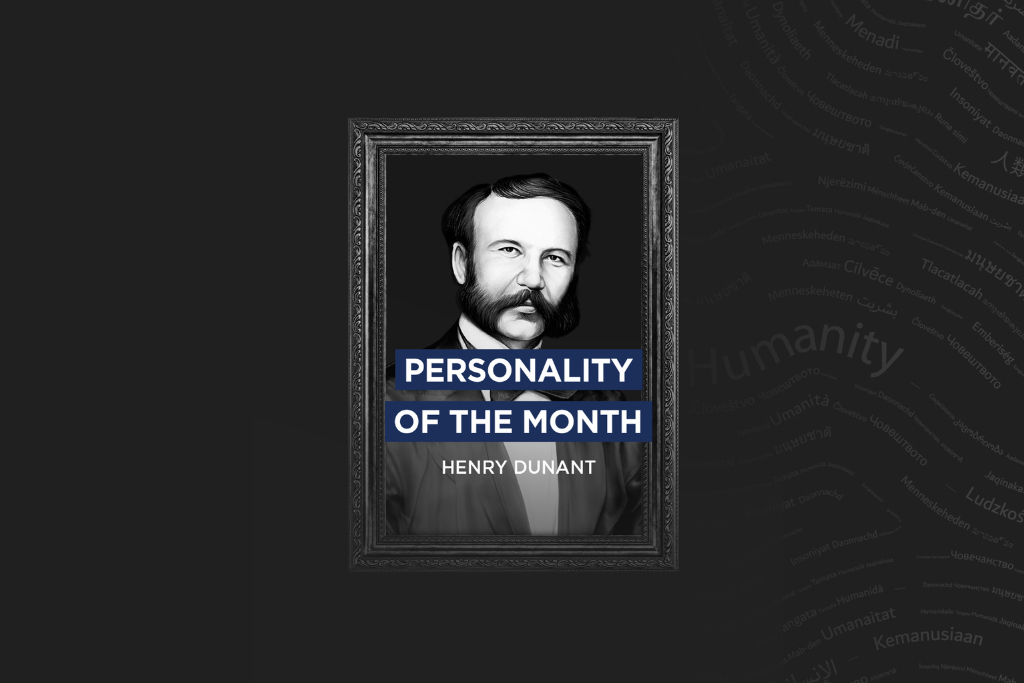
Henry Dunant
Henry Dunant, born in 1828 was a humanitarian, businessman, social activist, and co-founder of the Red Cross. His humanitarian efforts won him the first ever Nobel Peace Prize in 1901.
Humanitarian Work
Dunant always knew the importance of helping others in need. He had observed his parents help the sick, poor, orphans, and prison parolees. At age 18, following his parents’ example, Dunant joined the Geneva Society for Alms Giving, through which he volunteered time to care for the poor and sick.
Dunant became a member of the Geneva Organisation known as the “League of Alms” whose main purpose was to provide spiritual and material assistance to the poor and sick.
Dunant frequently visited Geneva Jails where he tried to rehabilitate and reintegrate prisoners.
Inspiration behind the founding of the Red Cross:
Dunant took a trip that would change his life.
In 1859, Dunant visited Emperor Napoleon III for business reasons, so he traveled to northern Italy where a military campaign was taking place. Henry witnessed firsthand the tragedy and horrors of war when he toured the area after the Battle of Solferino which was known as a particularly a slaughter for both sides. The battle had such an impact on Dunant where he returned to Geneva and wrote a book titled A Memory of Solferino describing what he had seen and published it at his own expense.
Dunant himself took the initiative to organize the civilian population, especially the women and girls, to aid the injured and sick soldiers. They lacked sufficient materials and supplies, and Dunant himself organized the purchase of needed materials and helped erect makeshift hospitals. He convinced the population to service the wounded without regard to their side in the conflict as per the slogan “Tutti fratelli” (All are brothers) coined by the women of nearby city Castiglione delle Stiviere. He also succeeded in gaining the release of Austrian doctors captured by the French and British.
Founding of the International Committee of the Red Cross
On February 7, 1863, the Société Genevoise d’utilité publique [Geneva Society for Public Welfare] appointed a committee of five, including Dunant which eventually founded the International Committee of the Red Cross.
On August 22, 1864, twelve nations signed an international treaty, commonly known as the Geneva Convention, agreeing to guarantee neutrality to sanitary personnel, to expedite supplies for their use, and to adopt a special identifying emblem – in virtually all instances a red cross on a field of white.
Dunant called for the creation of national relief societies to assist those wounded in war, paving the way for the future Geneva Conventions.
Dunant approved the efforts to extend the scope of the Red Cross to cover naval personnel in wartime, and in peacetime to alleviate the hardships caused by natural catastrophes.
In 1872 he convened a conference to establish the «Alliance universelle de l’ordre et de la civilisation» which was to consider the need for an international convention on the handling of prisoners of war and for the settling of international disputes by courts of arbitration rather than by war.
Dunant neglected his businesses and only concentrated his attention on humanitarian pursuits and neglecting his businesses.
Nice note to end on:
Dunant was awarded the first ever Nobel peace prize for his humanitarian efforts in 1901.
Passed away in 1910.
To conclude the story of Henry Dunant which is the official congratulations which Dunant received from the International Committee finally represented the rehabilitation of his reputation:
“There is no man who more deserves this honour, for it was you, forty years ago, who set on foot the international organization for the relief of the wounded on the battlefield. Without you, the Red Cross, the supreme humanitarian achievement of the nineteenth century would probably have never been undertaken.”
Dunant had not spent any of the prize monies he had received. He bequeathed some legacies to those who had cared for him in the village hospital, endowed a «free bed» that was to be available to the sick among the poorest people in the village, and left the remainder to philanthropic enterprises in Norway and Switzerland.
References:
https://www.ifrc.org/who-we-are/about-ifrc/our-history-and-archives
https://www.nobelprize.org/prizes/peace/1901/dunant/biographical/
https://www.youtube.com/watch?v=FK1xIwiBdWs