


DATE
December 9, 2025
CATEGORY
DIHAD News
SHARE


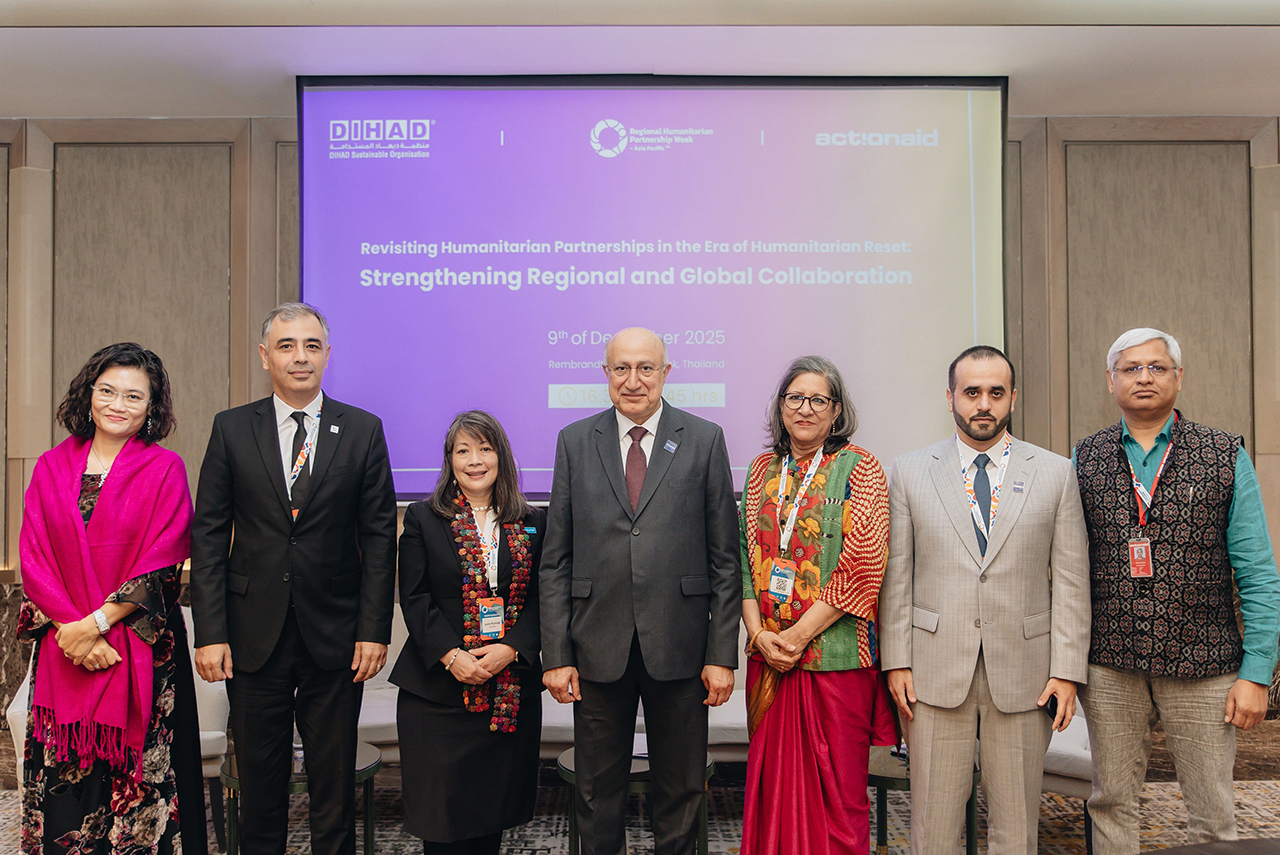
Bangkok, Thailand, 9 December 2025: DIHAD Sustainable Organisation hosted a high-level strategic session titled “Revisiting Humanitarian Partnerships in the Era of Humanitarian Reset: Strengthening Regional and Global Collaboration” during the Regional Humanitarian Partnership Week (RHPW) Asia Pacific 2025 in Bangkok. The session convened senior humanitarian leaders to explore how evolving global challenges are reshaping partnerships and to identify opportunities for more inclusive, resilient, and sustainable humanitarian outcomes across the Asia Pacific region.
Co-hosted with ActionAid International, the discussion brought together representatives from key regional and global institutions, including the International Federation of Red Cross and Red Crescent Societies (IFRC), the United Nations Children’s Fund (UNICEF), governments, civil society, and the private sector. Participants examined how humanitarian partnerships are evolving in light of global crises, shifting priorities, and funding challenges, and discussed ways to strengthen cooperation while promoting innovation and local leadership. The discussion emphasized the importance of linking global strategies with regional and local realities to ensure humanitarian efforts are timely, coordinated, and impactful.
Speakers highlighted the critical role of locally led action, capacity development, and community-centered decision-making as cornerstones of effective humanitarian response. They noted that sustainable and meaningful humanitarian action requires more than the efficient allocation of resources, it depends on empowering communities, leveraging local knowledge, and fostering partnerships that are transparent, accountable, and inclusive. Panelists underscored that collaboration among governments, UN agencies, NGOs, civil society, and the private sector is essential to address increasingly complex humanitarian challenges and to ensure continuity of support in regions affected by recurrent crises.
His Excellency Amb. Dr. Abdulsalam AlMadani Chairman of DIHAD Sustainable Organisation and Chairman of DISAB; Roving Ambassador of the Parliamentary Assembly of the Mediterranean (PAM) for the GCC Region stated: “This session reaffirms that the most important thing in humanitarian work is partnership. We are grateful to the host country, Thailand, and the organisers of the Regional Humanitarian Partnership Week Asia Pacific for bringing us together. Regional and global collaboration is essential to support vulnerable communities, not only during crises but also in helping communities rise out of poverty. When governments, international organisations, and civil society work together, we can achieve much more. At DIHAD Sustainable Organisation, we believe that partnerships built on trust, accountability, and inclusion will shape a stronger and more sustainable future for everyone.”
Additional insights were shared by Ms. Farah Kabir, Country Director of ActionAid Bangladesh and Member of the Advisory Board of the Platform for Disaster Displacement, who emphasized that we are at a moment when humanitarian challenges are evolving and unprecedented, making the call for a humanitarian reset urgent and unavoidable. She noted that this reset offers an opportunity to recalibrate approaches without compromising principles and to build partnerships grounded in respect, clarity, accountability, and above all, humanity.
The panel featured prominent humanitarian leaders, including Eng. Khaled Al Attar, Director General of DIHAD Sustainable Organisation, Mr. Elkhan Rahimov, Head of Country Cluster Delegation for Thailand, Cambodia, Laos, and Vietnam, IFRC; Ms. June Kunugi, Regional Director for East Asia and the Pacific, UNICEF, and Mr. Srikanta Misra, Country Director of ActionAid Afghanistan. The session was moderated by Ms. Hoang Phuong Thao, Executive Director of ActionAid Vietnam. Together, the panelists shared best practices, experiences, and practical recommendations to strengthen cross-regional cooperation and enhance resilience at the community level.
The session also underscored DIHAD’s role as a regional and global convener, providing platforms to foster dialogue, share knowledge, and build strategic partnerships through initiatives such as the DIHAD Humanitarian College, which trains the next generation of humanitarian leaders, and the DIHAD Conference and Exhibition, an annual platform connecting practitioners, policymakers, and innovators from around the world. These initiatives continue to reinforce DIHAD’s commitment to advancing strategic partnerships and sustainable humanitarian practices.
Supported by the UAE Aid, the United Nations, the International Federation of Red Cross and Red Crescent Societies, Mohammed bin Rashid Al Maktoum Global Initiatives, Dubai Future Council on Humanitarian Aid, UAE Red Crescent Authority, Dubai Humanitarian, and the Mohammed bin Rashid Al Maktoum Humanitarian and Charity Establishment, DIHAD continues to strengthen regional systems by prioritizing local leadership, inclusive partnerships, and innovation. These collective efforts enhance community resilience and ensure that humanitarian interventions are more coherent, timely, and sustainable.
Through its partnership-driven approach, DIHAD is working with regional and international actors to empower communities to lead their own recovery and resilience efforts. By fostering long-term collaboration, promoting knowledge-sharing, and encouraging innovative solutions, DIHAD and its partners are helping ensure that vulnerable populations receive meaningful, lasting support, even within the most complex humanitarian environments.
The session reaffirmed that effective humanitarian collaboration is multidimensional, integrating policy, capacity development, funding, innovation, and local engagement. Participants agreed that sustained investment in strategic partnerships and community empowerment is essential to strengthening resilience, accelerating emergency response, and ensuring no one is left behind.
About DIHAD Sustainable Organisation
DIHAD Sustainable Organisation is committed to empowering the world and making a tangible transformation in the lives of individuals and communities impacted by crises, disasters, and natural calamities while enabling communities to become more resilient by focusing on sustainable improvement, education, and efficient humanitarian initiatives, aid, and charitable endeavours. The Organisation aims to create a sustainable, resilient, and equitable world for all without any bias towards race, religion, ethnicity, gender or location.
About ActionAid:
ActionAid is a global federation working towards a world free from poverty and injustice. Their work focuses on four main areas: women, politics and economics, land and climate, and emergencies, with a particular emphasis on women’s rights, which form a central thread across all activities.
ActionAid was founded as a charity in the United Kingdom in 1972 and quickly expanded its presence to countries around the world. In the 1990s, they adopted a human rights-based approach to development, which has since guided all their programs and initiatives.